

What Did Representatives of the Lithuanian Police School Bring Back from Catalonia?
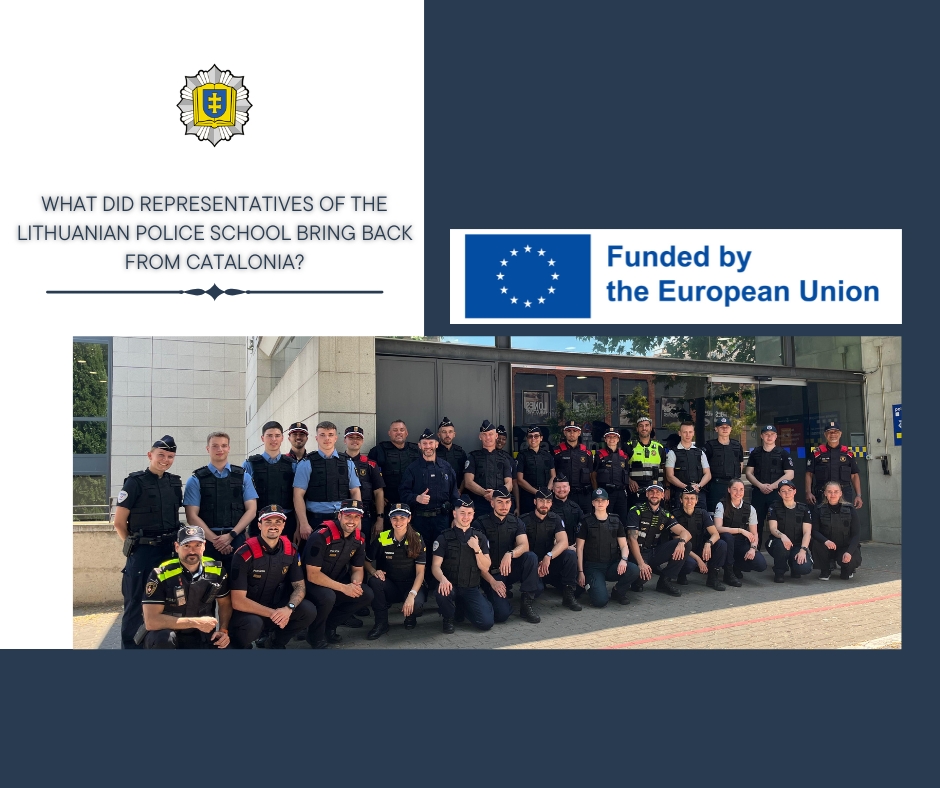
Representatives of the Lithuanian Police School (LPS), together with participants from France, Belgium, and Germany, took part in an international week hosted by the Catalan Police Academy. The programme offered a unique opportunity to gain first-hand insight into Spain's policing system, officer training, and the innovative technologies shaping the future of law enforcement.
The two-week Erasmus+ mobility programme provided participants with valuable experience of a different policing model while demonstrating how one of Europe's largest police organisations is preparing for the security challenges of tomorrow.
A Police Academy Training Up to 1,800 Future Officers at a Time
The first impression upon arriving at the Catalan Police Academy was its impressive scale. The 2025–2026 basic police training programme accommodates up to 1,800 future officers of the Mossos d'Esquadra and local police forces, making it one of the largest police training centres in Europe.
At the beginning of the visit, the LPS delegation was introduced to the Catalan policing system, the academy's organisational structure, and its officer training model. Participants also met cadets enrolled in the basic training programme and gained insight into their daily learning experience.
Four Police Forces Operating Within One Territory
One of the most striking differences between the Lithuanian and Spanish policing systems is their organisational structure. While Lithuania operates a centralised police service, public safety in Catalonia is ensured by several law enforcement agencies operating at different levels.
The region's primary police force is the Mossos d'Esquadra, working alongside local police services, the Spanish National Police, and the Guardia Civil. To better understand this multi-layered system, LPS representatives visited the Terrassa Local Police Headquarters and the Mossos d'Esquadra station in Sabadell, where they learned about the different responsibilities, operational structures, and cooperation mechanisms between the various police organisations.
Practical Training as a Core Element of Police Education
Practical training plays a central role at the Catalan Police Academy. LPS cadets participated in realistic policing simulations conducted in specially designed training facilities, working alongside Catalan cadets to resolve operational scenarios based on real-life situations.
They also took part in arrest tactics and officer safety training while learning how officers are prepared for public order policing. This area receives particular attention in Catalonia, where officers are regularly deployed to major public events, demonstrations, and locations that welcome millions of tourists each year.
Elite Units and a Virtual Shooting Range
One of the highlights of the visit was the tour of the Mossos d'Esquadra headquarters in Sabadell. There, the LPS delegation was introduced to several specialised units, including the Public Order Unit (BRIMO), the Special Intervention Group (GEI), the K9 Unit, the Bomb Disposal Unit (TEDAX), and the academy's state-of-the-art virtual shooting range.
The virtual firearms training system demonstrated how advanced technologies are transforming modern police education. These systems allow officers to train in a wide range of simulated operational scenarios, improving decision-making in environments that closely replicate real policing situations.
Modern technologies such as virtual shooting simulators and digital learning platforms contribute not only to more effective training but also to sustainability. By reducing the need for live ammunition, fuel, and other consumable resources, these solutions support environmentally responsible policing and align with the principles of Green Policing.
The Future of Policing: Artificial Intelligence and Data Analytics
The programme focused not only on current policing practices but also on future developments. The Catalan Police is currently implementing one of its most ambitious initiatives—the Future Operations Management Centre. This integrated platform will combine emergency calls, CCTV feeds, drone data, patrol reports, and publicly available digital information into a single operational environment. The objective is to identify potential threats more rapidly and enable faster, better-informed operational responses. Artificial intelligence is also becoming an increasingly important component of everyday policing. New AI-powered tools are being developed to assist officers with drafting reports, analysing information, and managing large volumes of operational data more efficiently.
Drones and Counter-Drone Capabilities
The Catalan Police continues to invest significantly in unmanned aerial technologies. Drones are widely used during search and rescue operations, public order policing, and the monitoring of large-scale events. At the same time, counter-drone systems are being developed to detect unauthorised unmanned aircraft, identify their operators, and neutralise potential threats. These technologies are already deployed to protect critical infrastructure and major public events.
Community at the Heart of Policing
The international week concluded with a visit to the Barcelona City Police (Guardia Urbana de Barcelona), where participants were introduced to the organisation's structure, operational model, and community-oriented policing philosophy. Barcelona is home to approximately 1.73 million residents but receives around 15.5 million tourists annually, with total visitor numbers reaching approximately 30 million each year. Managing public safety on such a scale presents significant challenges, including maintaining public order, managing large crowds, policing major events, and ensuring security in one of Europe's most visited cities.
Participants also visited the Joint Operations Centre and joined patrol officers on operational duties throughout the city. Community engagement, conflict de-escalation, and public trust are fundamental principles of policing in Catalonia. These values are embedded into officer education from the very beginning of their professional training.
An Experience That Offers a Glimpse into the Future
The international week in Catalonia provided far more than an introduction to another country's policing system—it offered valuable insight into the direction in which European law enforcement is evolving. Scenario-based practical training, exposure to specialised police units, artificial intelligence, and sustainability-focused technologies broadened participants' professional perspectives and demonstrated the growing importance of innovation in modern policing. Most importantly, programmes such as these strengthen European cooperation and shared values. Representatives of the Lithuanian Police School returned with new knowledge and practical ideas for enhancing the protection of human rights, improving policing practices, and contributing to the development of safe, open, and community-oriented societies.
At the conclusion of the programme, participants were awarded certificates recognising two weeks of professional development, intercultural learning, and international cooperation.
Last updated: 02-07-2026
Related news:
Virtual reality will modernise police training
“Learning Not from Textbooks, but from Experience”: U.S. Experts Trained Police Instructors
International Pilot Training of Police Officers "FIRST-TAC": The Use of Force and Tactical Medicine
FIRST-TAC Project Pilots New First Responder Training Curriculum in Croatia