

Professionals from Law Enforcement Agencies of Twelve Different Foreign Nations, as well as Representatives From the Ambulance Service, the Public Security Service, and the Lithuanian Riflemen‘s Union, Enhanced Their Abilities in a Training Session Held at the Lithuanian Police School
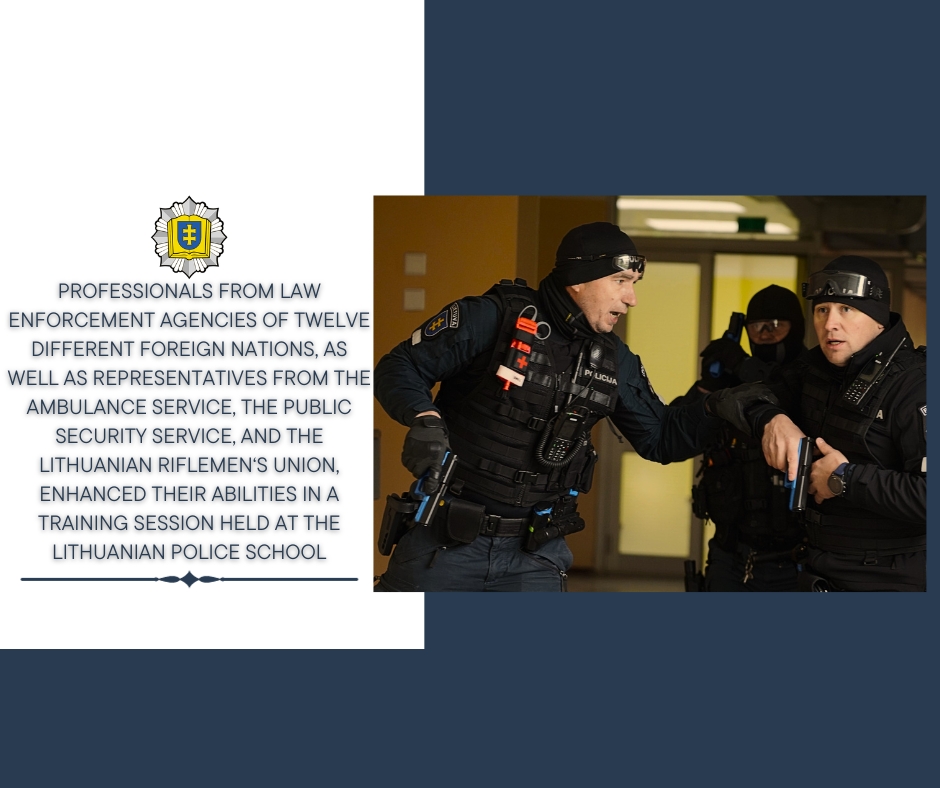
In response to sudden (unexpected) incidents of uncontrollable anger and aggression outbreaks (hereinafter - AMOK), the European Union High Risk Security Network (hereinafter - EU HRSN) and the Lithuanian Police School (hereinafter - LPS)organized an international training program at LPS that lasted for a week.
The main aim of the EU HRSN, in which representatives of LPS actively participate, is to arrange the collaboration of international law enforcement organizations in the fight against terrorism and to safeguard public areas (institutions). The aforementioned network concentrates its activity not just on special police forces but also on all other groups of law enforcement officers, including response officers, traffic police, riot police, criminal police, and so forth. Five working groups have been formed inside the network as a result of member agreement. The third working group focuses on the tactical actions of law enforcement officers while responding to received reports and providing aid to victims. This group's activities involve not only exchanging best practices but also trainings on what officers should do when they receive reports of incidents as well as how to evacuate people from dangerous locations and provide them emergency medical assistance, and take other steps to ensure their safety. The training of the aforementioned group has recently been arranged at the LPS.
More than 50 officers from several European nations, including the Czech Republic, Estonia, Latvia, Greece, Ireland, France, Spain, and Italy, as well as partners from Ukraine, Georgia, and Poland, attended the event. During the training, ambulance workers, representatives of the Public Security Service under the Ministry of the Interior, and the Lithuanian Riflemen's Union were additionally involved in the training to learn how to act together with the officers.
This type of training is a unique opportunity to bring together international best practices to develop the most appropriate algorithms for providing emergency assistance to victims, ensuring security and restoring public order in AMOK situations. According to one of the training organizers and the head of the LPS Professional Skills Board, Simonas Baltrušaitis, your safety is the priority in AMOK situations. It is important to quickly assess your surroundings and find cover or shelter. If possible, call 112 to report the incident. It's advisable to remain calm, speak quietly to people, lock the door, turn out the lights, and mute your phone.
Last updated: 15-11-2023
Related news:
What Did Representatives of the Lithuanian Police School Bring Back from Catalonia?
Virtual reality will modernise police training
“Learning Not from Textbooks, but from Experience”: U.S. Experts Trained Police Instructors
International Pilot Training of Police Officers "FIRST-TAC": The Use of Force and Tactical Medicine
FIRST-TAC Project Pilots New First Responder Training Curriculum in Croatia